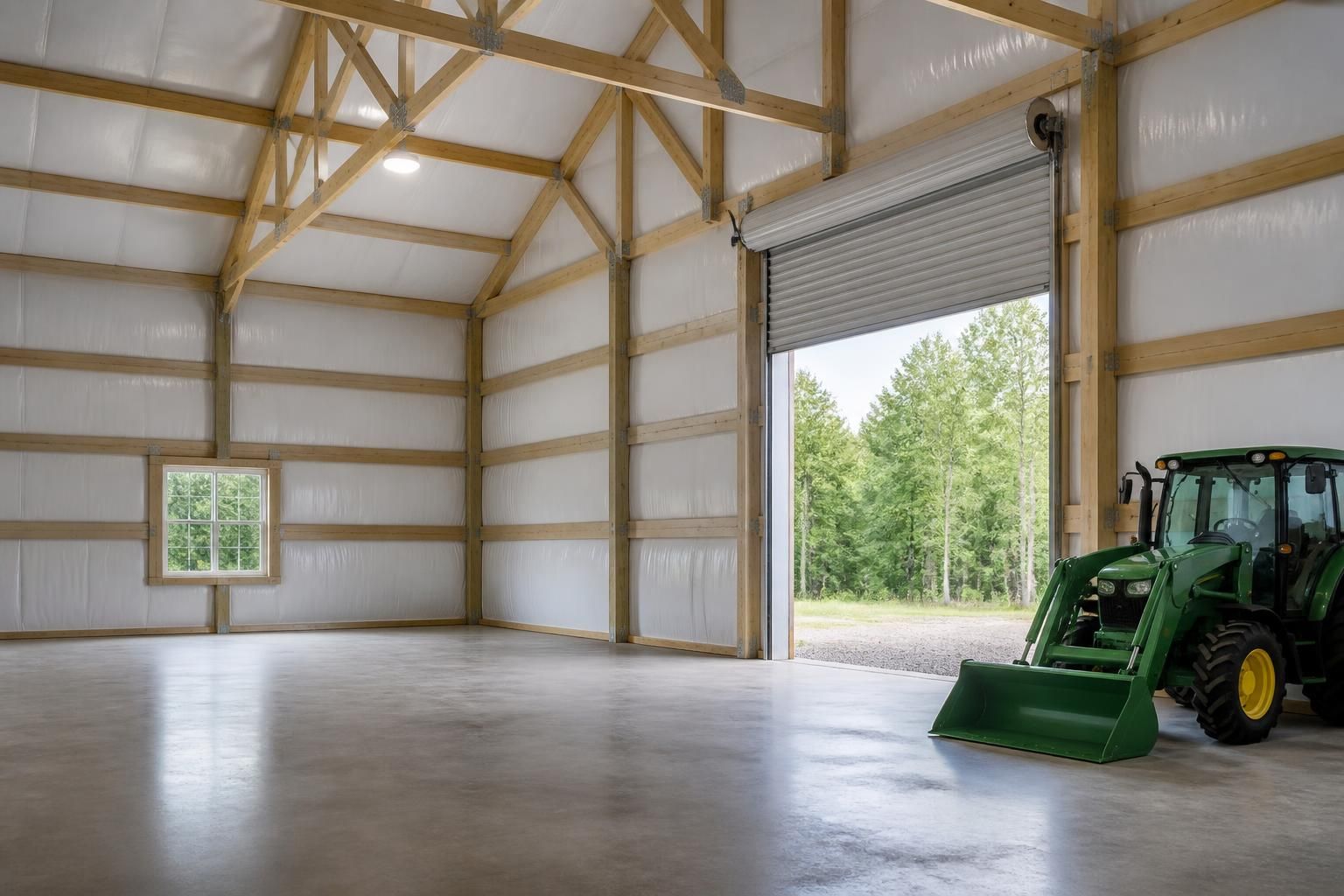
If your pole barn feels too hot by midday, too cold early morning, or noisy every time the weather shifts, the shell is probably giving up more than you want it to. Gaps around framing, roof lines, and wall panels can let air move freely through the building, which makes storage harder and work less comfortable.
Douget's Spray On Spray Foam Insulation helps property owners around Madisonville, TX seal those weak spots with insulation made for pole barns, metal buildings, and other open structures. We look at how the building is used, where air is escaping, and what kind of coverage makes sense for your goals before we get started.
Pole barns are built to be versatile, but their open framing and metal surfaces can create a lot of temperature swing. If you use the space for equipment, animals, tools, inventory, or work projects, those swings can affect comfort and the condition of what you store inside.
Uninsulated or lightly insulated pole barns often show the same warning signs:
When those signs show up, spray foam can help turn the building into a more controlled space without changing the way the barn is used.
Pole barn insulation works differently from loose-fill or basic batts because spray foam expands to cover irregular spaces. That matters on buildings with framing members, seams, corners, and roof transitions that are hard to seal with standard materials.
Spray foam creates a tighter envelope by filling cracks and small openings that let conditioned air escape and outside air enter. That can make a noticeable difference in comfort, sound control, and the way the space holds temperature.
Metal buildings can collect moisture where warm air meets cooler surfaces. Insulation that helps reduce air movement can also help limit the conditions that lead to dripping, dampness, and wet spots around framing and panels.
Pole barns are rarely simple boxes. Rafter lines, posts, braces, and attachments create lots of edges. Spray foam can follow those shapes, which helps create more complete coverage than rigid material in many cases.
Every pole barn has different weak points, so we focus on the parts of the building where heat and air movement show up most. That often includes the roofline, perimeter walls, and areas around structural members.
Common areas we address include:
Douget's Spray On Spray Foam Insulation can also discuss whether your building needs partial coverage or a broader insulation plan based on how you use the space.
Some pole barns are only used now and then, while others are part of daily work or storage. The way you use the structure matters because a building that holds equipment needs a different result than one used for hobbies or seasonal work.
Pole barn insulation can help support spaces used for:
If you are trying to make the space easier to use through more of the year, insulation is often one of the first improvements worth considering.
We keep the process straightforward so you know what is being addressed and why. The goal is to match the insulation work to the structure rather than forcing a one-size-fits-all approach.
With Douget's Spray On Spray Foam Insulation, you get a practical process focused on the building you already have, not a generic setup meant for another type of structure.
Some pole barn problems are easy to ignore at first because the building still seems usable. Over time, though, the same issues can make the space harder to rely on.
If the temperature seems to swing hard from morning to afternoon, the building may be losing control through the roof or walls.
Dust, dampness, and temperature shifts can affect stored materials, tools, and equipment even when the barn looks sealed from the outside.
If rain, wind, or outside activity seems overly loud, insulation may help soften how sound moves through the shell.
For many owners around Madisonville, TX, these signs are what turn a pole barn from a simple shell into a more usable space with better control.
Douget's Spray On Spray Foam Insulation serves Madisonville, TX and nearby communities across Central Texas, including Huntsville, Bryan, College Station, Navasota, Crockett, Centerville, Caldwell, and Franklin. That local focus matters because pole barns here often serve practical needs, not just storage.
We work with property owners who want a clearer plan for insulation without unnecessary extras. If your building needs attention for comfort, storage protection, or energy control, we can help you decide what makes sense for the structure and the way you use it.
We are locally owned and operated, and we have spent years serving the area with hometown values. That means clear communication, straightforward recommendations, and insulation work centered on your building’s actual needs.
Yes. Many pole barns are insulated after construction. Retrofit insulation can help improve comfort and air control without starting over with the structure.
Spray foam is often a strong fit for metal buildings because it can help seal seams, corners, and framing areas where air tends to move through.
It can help reduce how quickly the space heats up or cools down by limiting air movement and adding resistance along exposed surfaces.
Roof areas, wall panels, joints, and framing gaps are often the first places to review because they commonly let outside air move through the building.
Yes, insulation can help soften sound transfer through the structure, which may make rain, wind, and outside activity less noticeable inside.
Not always. Some pole barns benefit from targeted coverage, while others need broader insulation. The right approach depends on how the building is used and where the biggest problem areas are.
If your pole barn in Madisonville, TX feels hard to control or is not protecting the space the way it should, spray foam insulation can make a real difference. Douget's Spray On Spray Foam Insulation offers free insulation estimates and straightforward guidance for pole barns, metal buildings, attics, crawl spaces, and more.
Call +19364380252 or email jandtdouget@yahoo.com to talk through your project and schedule a visit. We are open Monday through Friday, 8:00 AM to 6:00 PM, and ready to help you plan the next step for your building.
Request a Quote
Tell us about your building, attic, or crawl space and we will help you choose an insulation approach that fits your property and your goals.